
Meet our Accelerators - Patricia Beckmann
By Helena Strigård, CEO
September 1, 2026
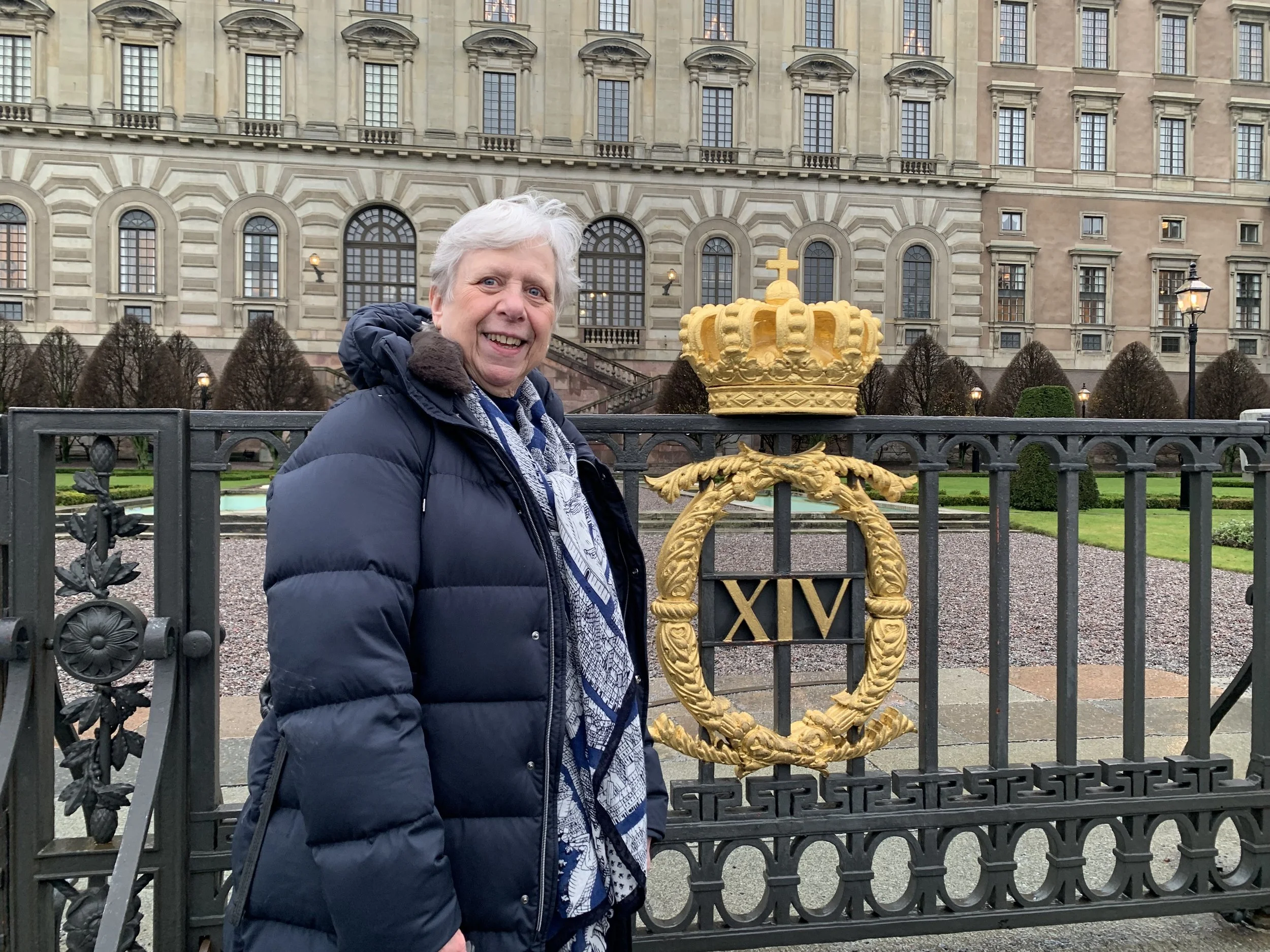
Patricia Beckmann, Senior Advisor
Forty years ago, a young American biochemist arrived in Uppsala with her husband and a baby son, on a Fulbright fellowship to the Ludwig Institute for Cancer Research - the first postdoc, and to this day the only American postdoc, in the lab of Professor Carl-Henrik Heldin. This year, Patricia Beckmann returned to Uppsala for the institute's 40th-anniversary symposium, one of nearly 150 alumni travelling from all over the world to honour their mentor.
In between those two Swedish moments lies one of the life science industry's great zigzag careers. She is among the inventors of the blockbuster autoimmune drug Enbrel, born from her work on tumor necrosis factor receptors at Seattle's Immunex. She has been a venture investor at Paul Allen's Vulcan Ventures, a Kauffman Fellow, and a biotech ecosystem builder as founding head of Oregon's translational research institute OTRADI - and an entrepreneur whose own ventures have ranged from wastewater testing during the pandemic to genetically engineered dander-free cats. Science magazine summed it up in a headline: "A Zigzagging Path Points Straight to Success."
Now she brings that path - and her deep roots in the Seattle life science ecosystem - to Ventures Accelerated as an Accelerator. Founder Helena Strigård asked her where all that curiosity comes from.
You have done quite a lot in your career. What keeps someone curious across so many arenas?
I guess it is my overall curiosity and my wish to make the world a better place. My career has certainly been an evolution. If I saw something interesting, or wanted to approach a new area that could make a difference - say, wastewater testing during Covid to track the virus, or pushing the envelope to make dander-less cats - I had to understand not just if there was a market, but also how the technologies worked and how to finance their development.
You have moved from academia to industry to the investor side of the table. What were the toughest lessons along the way?
I really never was an academic. I got my PhD and taught, but never wanted to work my way up the academic ladder. I wanted to create solutions to problems - initially to vindicate my mother's death, and later simply to solve technical problems. Industry seemed the right place to do that, if it was an entity that embraced creativity.
That is exactly how the project that became Enbrel started at Immunex. We were allowed to spend up to 200 hours on exploratory research alongside our official projects, and only then present the idea to senior management, who would either kill it or give it a priority and a budget. Knowing that the cytokine TNF had some nasty effects in inflammation, sepsis and other conditions, I devised a way to isolate and clone the receptor DNA, to use it as an antagonist - a sponge - to block TNF's activity. Management liked the idea and gave it their blessing.
Watching some of my successes put on a shelf, or licensed to other companies without any input from me, was very frustrating. I was "just a scientist" - what did I know about market opportunities? So I had to learn. I had to learn about intellectual property - I worked at a company that closed because it lacked proper IP coverage on its product, a learning experience all of its own - and then about how to finance a new entity. Essentially, I followed my gut as to what I needed to learn, watched and listened to others' successes and failures, and then tried something of my own.
Overall, I found that you learn more from your failures than your successes. But you need to keep trying until something clicks on multiple levels. Having a varied background also made it easier to talk with other founders - I could help them see pitfalls they had not considered and find palatable ways to pivot. If there is one superpower I have, it is bringing that multi-disciplinary approach to the table, talking both the science and the business, and helping an idea become a reality.
You are in Sweden for the Ludwig Institute's 40th anniversary. What made that period of your life so special?
I was a young PhD with a family, and I had never been outside the U.S. before. I have always believed that geographical and cultural differences are a bonus to be sought when choosing where to study or work - and many things about Sweden turned out to be special in ways I never expected.
I did not expect Sweden to be as culturally diverse as it was in 1985. The Fulbright Foundation found us an apartment in Flogsta outside Uppsala, where many recent refugees also lived - potlucks with neighbours, talking about where they came from, politics, world problems, and of course great international food. It was one of the richest experiences of my life. A Chilean family essentially adopted us, and their grandmother - Grandma Lopez - took care of my son during the day. She spoke only Spanish, so Spanish became my son's first language. Sweden taught us the positive aspects of cultural difference, and that has carried into an interest in other cultures and travel in all my children.
And then there was Calle. I was Dr. Heldin's first postdoc - and the only American one ever! I was impressed by his attitude toward science, and little did I know how much he would influence my scientific approach, my ethics, learning to stand up for myself and when to walk away. He taught me not to publish work before you have a full story to tell, even if someone might beat you to it - advice that served me well throughout my career. Only at the 40th-anniversary symposium did I learn the full list of tenets that guide Calle's work and life: empathy, determination, honesty, resilience, creativity, patience, generosity, authenticity, humility, commitment. That is why nearly 150 of his former students, postdocs and visiting scientists showed up from all over the world to honor him. I was lucky to have him as my first mentor. It laid a foundation for me.
Coming back to the Swedish life science arena after all this time - what has changed?
In 1985-86, life sciences as an industry had barely begun, in Sweden or anywhere. Biotech was just taking hold, and many thought it was a passing fancy that would not last. I was even discouraged from going into biotech and told I should be an academic - I sure am glad I did not heed that advice. Back then, innovation was seen to emerge from academic institutions; I remember being in awe the first time I walked into the Karolinska. As I recall, Pharmacia was the only major industry player in Sweden - though when I later worked on cytokines and receptors at Immunex, I can sure tell you that Pharmacia's technology played a huge part in our success studying protein interactions. Today, Sweden has a genuine life science industry standing on that foundation of innovation.
As someone rooted in the Seattle life science ecosystem, what co-creation would you ideally wish to see between these two clusters?
I would love to see an exchange program - Washingtonians experiencing how the sense of collaboration and innovation in Sweden has propelled the country's life science community, and Swedish counterparts seeing what works (and does not work) in the US. Not a formal technology-only exchange, but something all-encompassing: early- and later-stage companies and academic exchanges on mentoring, start-ups, financing, technologies and future potential. With incubators, accelerators, companies and universities participating in week-long on-the-ground experiences and seminars, new technological and structural collaborations could further drive both economies - with appropriate IP considerations in place, of course!