
At BIO 2026, partnerships moved beyond the deal.
By Helena Strigård, CEO and Founder
September 1, 2026
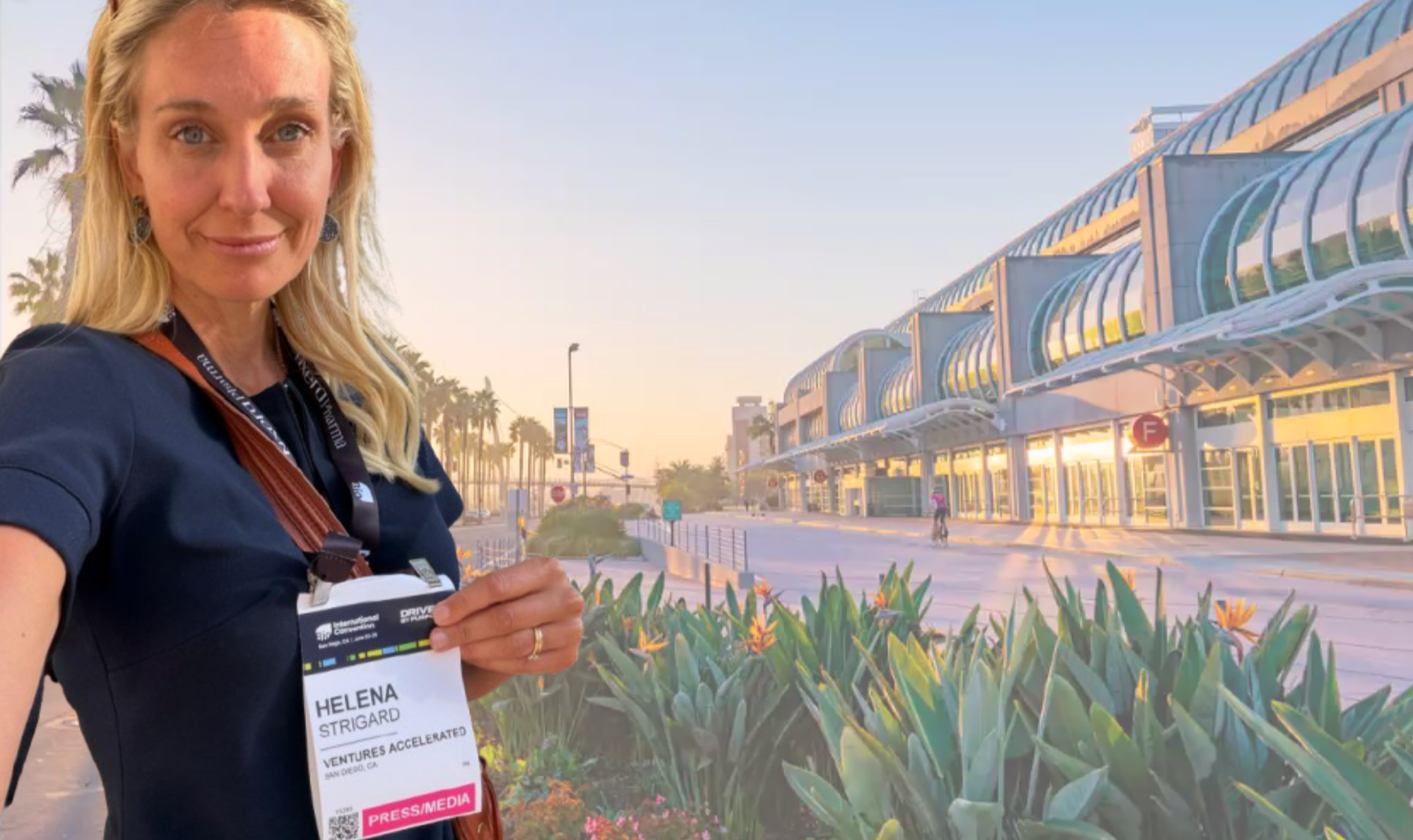
Helena Strigård
CEO and Founder of Ventures Accelerated
Global partnering was not slowing down at BIO 2026 — it was growing more deliberate, more operational and more interconnected. A view from San Diego across six companies navigating the path from scientific promise to global execution.
"Great science can bring parties together, but execution is what ultimately determines whether a partnership delivers on its promise."
That observation, from Suefen Kwa of Emergent BioSolutions, captured something running beneath many of this year's conversations.
Companies still came to BIO to find assets, investors, licensees and development partners. But the most revealing discussions were not simply about whether a deal could be signed. They were about what would happen afterwards.
Can an asset be developed across several regulatory systems? Can evidence generated in one region support progress in another? Can the company manufacture reliably, integrate a new program, and maintain alignment when development becomes difficult?
The deal, increasingly, is not the destination. It is the beginning of an operating model.
Innovation is crossing borders earlier
AddGraft Therapeutics is an early-stage biotechnology company developing engineered cell therapies through a non-viral transfection platform. Its lead program targets epidermolysis bullosa, a rare genetic skin disorder that causes fragile skin and widespread wounds.
The company is developing a topical "liquid graft" intended to combine the durability of a conventional skin graft with the flexibility of a formulation that can be applied across larger areas of the body.
AddGraft is raising a seed round and preparing several months of animal-model testing to validate the formulation. Even though AddGraft is early-stage, CEO Nick Bayhi's international strategy has already begun.
Rare-disease patients, advocacy organizations, and specialist clinical centres are dispersed across different countries by definition. One of the advocacy groups working in AddGraft's lead indication is based in Europe — where the company has no footprint at all. So Bayhi spent his week at BIO meeting European CDMOs and CROs against a trial he cannot yet fund.
"If I were to lead a clinical trial there, I wanted to know who to call," he said.
That is the whole strategy in a sentence. Global strategy now starts before financing — and for an early-stage biotech it does not mean opening international offices. It means assembling the network, the regulatory understanding, and the operational options required to move the moment capital arrives. Bayhi calls it building the Rolodex.
AddGraft represents the earliest point in the partnership chain: a small company preparing international infrastructure before its first major value-inflection point. But once an asset begins moving across borders, another question emerges — how should different regions divide the work of developing it?
China becomes part of the global development engine
Hansoh Pharma is a large and profitable Chinese pharmaceutical company with approximately 9,000 employees, more than 2,000 people in research and development, and a commercial organization of around 5,000.
Its international strategy operates in both directions. Hansoh licenses global products and platforms for development and commercialization in China, while also advancing internally discovered assets through early clinical stages before partnering their ex-China rights.
Chief Business Officer Weiyong Sun described the split as follows:
"In China, we can do everything by ourselves," he said. "Currently, outside of China, we can only do the phase one clinical studies. After phase two, we prefer an external partner to help us on clinical development and commercialization."
Coming from an organization of that scale, this is not modesty. It is an operating decision, stated as plainly as a balance sheet.
Hansoh can use its robust discovery, clinical, manufacturing and commercial infrastructure in China to advance programs efficiently. International partners contribute to larger global studies, regulatory experience with the FDA and EMA, and commercialization networks the company does not have outside its home market.
The consequence is that China is no longer a market entered near the end of development. It has become an integrated part of the global innovation process, generating early clinical evidence that can inform and accelerate development elsewhere.
Hansoh's model demonstrates how regional specialization can move an asset more efficiently. But clinical speed alone does not guarantee a successful global program. The evidence still has to answer the questions that regulators and eventual commercial partners consider decisive.
Selecting for Execution, Not Just Innovation
Emergent BioSolutions works across public-health preparedness, medical countermeasures, biodefense— a domain where partnerships must hold up under conditions few conventional pharmaceutical deals face. Products may sit in national stockpiles for years; manufacturing may have to surge during an emergency, and supply chains must survive geopolitical disruption and sudden shifts in demand.
That environment makes strategic fit only the first of three filters. Emergent also weighs the scale of the unmet need, then asks whether its capabilities can meaningfully accelerate development, manufacturing or delivery. The third filter is execution feasibility and whether there is a realistic path forward.
"Saying 'yes' to the right opportunities requires being disciplined about saying 'no' to many others," said Suefen Kwa, Head of Evaluations. "The goal is not simply to identify compelling science, but also to identify opportunities where both parties can create more value together than they could independently."
Disciplined partnering, then, depends as much on refusal as on discovery. The strongest scientific concept does not make the strongest partnership if roles are poorly aligned, incentives diverge over time, or the path to reliable execution is uncertain. In public-health preparedness, that discipline is not merely financial. It determines whether a product can be produced, scaled and delivered when it is required.
Emergent's experience exposes the physical infrastructure sitting underneath a partnership strategy. The same constraint is now surfacing in a much faster-moving part of biotechnology, where computational design has begun to outrun the systems that have to build the results.
Manufacturing must catch up with drug design
Invitris is a biotechnology company developing cell-free expression systems designed to produce biological molecules without relying on conventional living-cell manufacturing.
Its thesis begins with a mismatch. Artificial intelligence can generate increasingly complex and customized drug candidates. Many of those designs are difficult or uneconomic to manufacture — and a significant share of them, being genuinely de novo, cannot readily be produced at all.
"AI is great at customizing drugs for virtually any patient, but we are providing the manufacturing layer to actually scale them," said CEO Patrick Grossmann.
The next bottleneck in AI-enabled drug development, on this reading, is physical rather than computational. Cell-free expression lets Invitris prototype biological products faster and produce them in smaller, distributed units — scaling throughput rather than volume, with applications in personalized medicine, antimicrobial resistance and the onshoring of critical supply chains.
The economic case is the sharper one. Personalized approaches have struggled not because science is impossible but because the margins do not support a business; change the manufacturing layer, and you change whether the category exists commercially at all. Invitris, in short, is the production layer beneath increasingly sophisticated discovery — which raises a question for the companies generating those designs: not whether they can discover faster, but what they ought to own when they do.
AI is moving from faster discovery to asset ownership
Anyo Labs is a Swedish AI-native drug-discovery company, spun out of computational chemistry research at the University of Gothenburg, whose platform screens large molecular libraries more efficiently than most AI companies relying on 3D and physics-based models. It reports completing more than 17 projects across oncology, infectious disease, inflammation and neurodegeneration, has expanded from small molecules into peptides, and is advancing an internal chronic-inflammation program toward in vivo proof of concept.
That track record is changing what the company sells. Where AI-discovery firms once positioned themselves as software providers, many now seek equity, revenue-sharing and co-ownership structures that let them share the long-term value of the assets they help create.
"The companies that will define the next decade are those that have built proprietary, validated AI capabilities and are utilising them internally, not just to provide faster services," said CEO MarekSzczygiel.
Despite the highly efficient models built at Anyo, speed alone may not produce a defensible business. As the cost of reaching a validated hit falls, that advantage becomes easy to commoditize; durable value depends on owning a stake in the programs that succeed. But moving deeper into the value chain also means inheriting every other developer's constraint — a candidate discovered rapidly in silico still has to be produced, tested and manufactured at scale.
Anyo is deliberately moving further in. The final company in this piece has spent its existence deliberately staying out.
Not every company needs to build the whole chain
Chiome Bioscience is a Japanese biotechnology company developing therapeutic antibodies intended to be licensed to external partners for later-stage development and commercialization.
The company does not maintain its own sales force. Its business-development team therefore approaches BIO with the main purpose: identify suitable out-licensing partners for pipeline programs at the stages where another organization is better positioned to carry them forward.
"Chiome has no sales force, and therefore one of our goals is to license our products at certain stages to other parties," said Koji Naito, Senior Director of Alliance and Strategy.
He also said, “the secondary purpose is to identify collaboration partners for Chiome’s novel technology to discover therapeutic bispecific antibody”. “The technology is named “DoppeLib” DoppeLib enables us to screen up to millions of bispecific candidates in several months with very limited resources,” he added.
Global growth does not require every biotechnology company to reproduce the complete pharmaceutical value chain internally. Licensing and collaboration can be the business model rather than the fallback used when independent development becomes too difficult.
Specialization creates dependence on partners. It also creates efficiency. A discovery company can concentrate on generating assets and technologies while organizations with the right clinical, manufacturing or commercial infrastructure take responsibility for the stages where they are strongest.
From transaction strategy to execution strategy
Taken together, the conversations at BIO 2026 describe an industry becoming more specialized — and therefore more dependent on collaboration. The old image of partnering was linear: discover an asset, generate evidence, find a buyer, sign a deal. What San Diego showed instead was a network.
Scientific quality still opens the conversation. But the questions that decide which programs move forward are increasingly operational — who can develop the asset, manufacture it, integrate it, and stay committed once the difficult work begins.
The most credible strategies at BIO 2026 were not built around doing everything internally or extracting maximum value at signing. They were built around knowing which capabilities matter, finding where they already exist, and bringing them together early enough to turn scientific promise into something that reaches patients.