
Down the Biotech Rabbit Hole
By Anders Månsson, Senior Advisor at Ventures Accelerated
Occtober 1, 2026
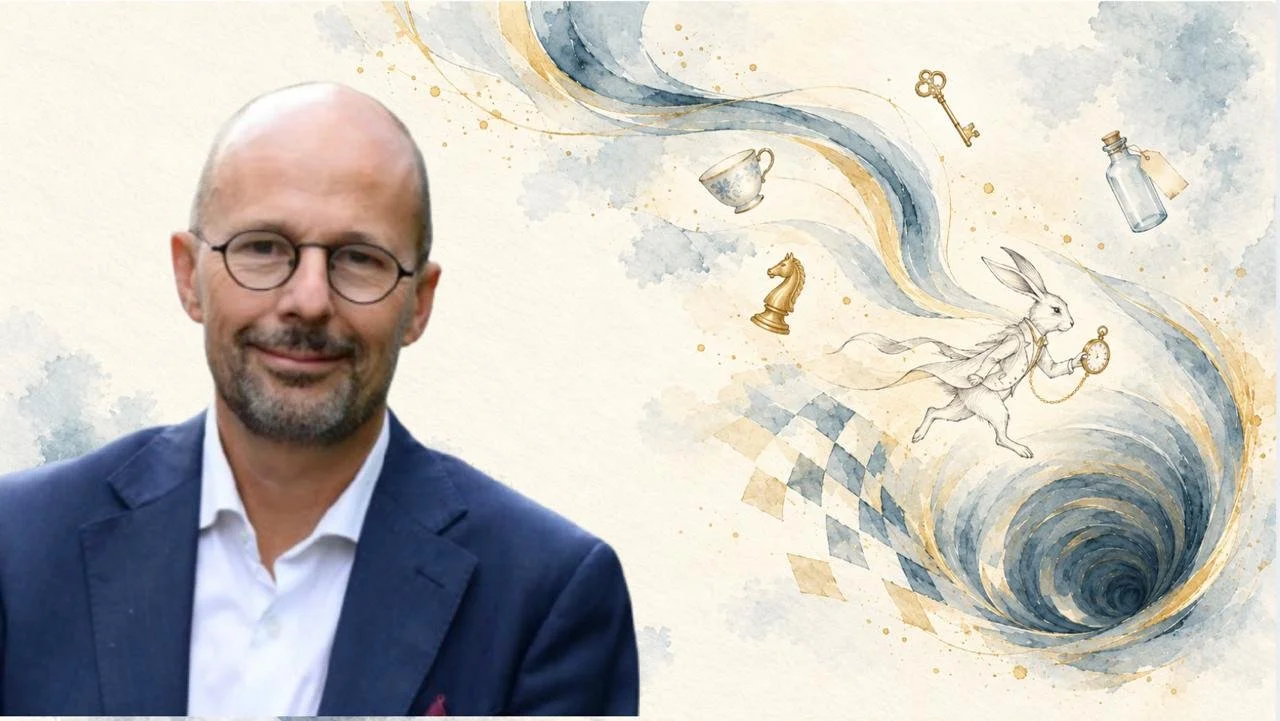
Anders Månsson, Senior Advisor at Ventures Accelerated
Biotech has always required a certain tolerance for absurdity. It asks founders, scientists, investors, regulators, and strategic partners to believe in molecules that cannot yet prove themselves, markets that do not yet exist, trial outcomes that refuse to obey spreadsheets, and valuations that can grow or shrink like Alice after a suspicious sip from a bottle labelled “DRINK ME.” The industry’s central promise remains magnificent: to transform deep science into medicines that relieve suffering and create durable value. But today, the path from discovery to commercial reality increasingly resembles Wonderland, not because the science is unserious, but because the rules of capital and partnering have become “curiouser and curiouser”.
The funding environment is no longer the splendid tea party of 2020 and 2021, when capital arrived in generous pots and every platform company seemed to have a Cheshire Cat grin. However, nor is it quite the frozen landscape of the post-pandemic 2022–2023 downturn, when public markets shut, generalist investors vanished, and companies learned that “runway extension” was simply a polite phrase for layoffs, pipeline pruning, and doing less with conspicuously less. By 2026, signs of recovery are visible: IPO activity has returned, venture financing has improved, and large pharmaceutical companies continue to pursue external innovation through licensing and M&A. Yet this is not a return to easy money. It is a narrower door, and like Alice, biotech must decide whether to shrink, stretch, or change shape entirely to pass through it.
The Queen’s Verdict: “Off with their burn rates!”
The most immediate challenge in biotech funding is not a total absence of money; it is the increasingly severe judgment applied to how that money is spent. Investors have become the Queen of Hearts standing over every budget line exclaiming: “Off with their burn rates!” Companies are expected to show focus, capital efficiency, and a believable route to the next value inflection point.
This brings a professional discipline that the sector arguably needed. Too much cheap money encouraged too many companies to advance too many programs with too little evidence. But the pendulum can also swing too far in the other direction. When investors demand proof too early, truly novel science may struggle to survive long enough to provide it. The biotech paradox is that the most valuable breakthroughs often look least bankable at the moment they most need capital. Alice’s problem was not that Wonderland lacked doors; it was that every door required her to be a different size. Biotech companies face the same dilemma: to be large enough to matter, small enough to conserve cash, advanced enough to attract capital, and early enough to preserve upside.
The Mad Tea Party of Commercial Partnering
If funding is Wonderland’s locked door, partnering is the Mad Tea Party: everyone is talking, nobody quite agrees what time it is, and the seat you thought was available has just moved. Large pharmaceutical companies need external innovation more than ever. Patent cliffs, portfolio gaps, productivity pressures, and shareholder expectations all push them toward biotech. On paper, this should create a seller’s market for high-quality innovation. In practice, partnering is becoming more selective, more structured, and more cautious.
Big Pharma wants assets with clear differentiation, compelling human data, manageable development risk, and a commercial role that fits existing infrastructure. The ideal target has the novelty of Wonderland but the operational predictability of a Swiss railway timetable. Unfortunately, most biotech assets do not arrive so conveniently packaged. Mechanisms are promising but unproven. Trials are small. Regulatory pathways are evolving. Manufacturing may be complex. Competitive landscapes may shift between the first partnering discussion and the second confidentiality agreement. The White Rabbit was always late; in biotech, the market could be late, early, crowded, or suddenly irrelevant.
Partnering discussions today therefore begin earlier on commercial questions. Who exactly is the patient? What is the treatment setting? How will physicians change behavior? What evidence will payers require? Can the product compete against standard of care, generics, biosimilars, cell therapies, biologics, small molecules, digital interventions, or simply therapeutic inertia? A biotech asset must know what it wants to be when it grows up.
This is particularly challenging in crowded hot areas. Obesity, oncology, immunology, radiopharmaceuticals, antibody-drug conjugates, gene editing, and AI-enabled discovery all attract capital and attention. But attention also invites comparison. The more crowded the field, the more unforgiving the question becomes: why this asset, why now, why this company, and why should anyone believe the answer? In Wonderland, the Cheshire Cat could disappear and leave only a smile. In biotech, a company that cannot explain its differentiation may discover that only the pitch deck remains.
For biotech executives, the practical lesson is to manage valuation as a narrative of risk reduction rather than a single number. What must be true for the asset to be worth more in twelve months? And perhaps even more important – what would have to happen for things to go really wrong?
Through the Door: What Good Looks Like Now
The best biotech companies today are neither naïve dreamers nor cynical deal machines. They are disciplined optimists. They recognize that capital is available but discriminating; that partners are hungry but risk-aware; that differentiation must be proven, not proclaimed; and that commercial value must be considered long before launch. They can speak science to scientists, risk to investors, opportunity to pharma, and purpose to patients.
The industry’s current challenge is therefore not simply funding scarcity or partnering caution. It is translation. Biotech must translate biological insight into investable propositions, investable propositions into developable products, developable products into partnerable assets, and partnerable assets into medicines that matter. Each translation loses something unless designed carefully. Each requires judgement. Each rewards companies that know what evidence will open the next door.
There is, of course, no guaranteed path through to Wonderland. Some rabbits lead nowhere. Some cakes make companies too large for their capital structure. Some tea parties consume months and produce only minutes. Yet the sector remains one of the few places where improbable ideas can profoundly change society. That is why investors return, why pharmaceutical companies search externally, and why biotech founders keep chasing white rabbits into laboratories at unreasonable hours.
At the end of the day, the professional communication challenge both in partnering and in raising capital could be summarized as “making the improbable credible”. Succeeding in this task is vital to secure the means that will allow you to explore the path that – possibly – leads to Wonderland.