
The Hard Middle of Biotech
By Helena Strigård, CEO
July 7, 2026
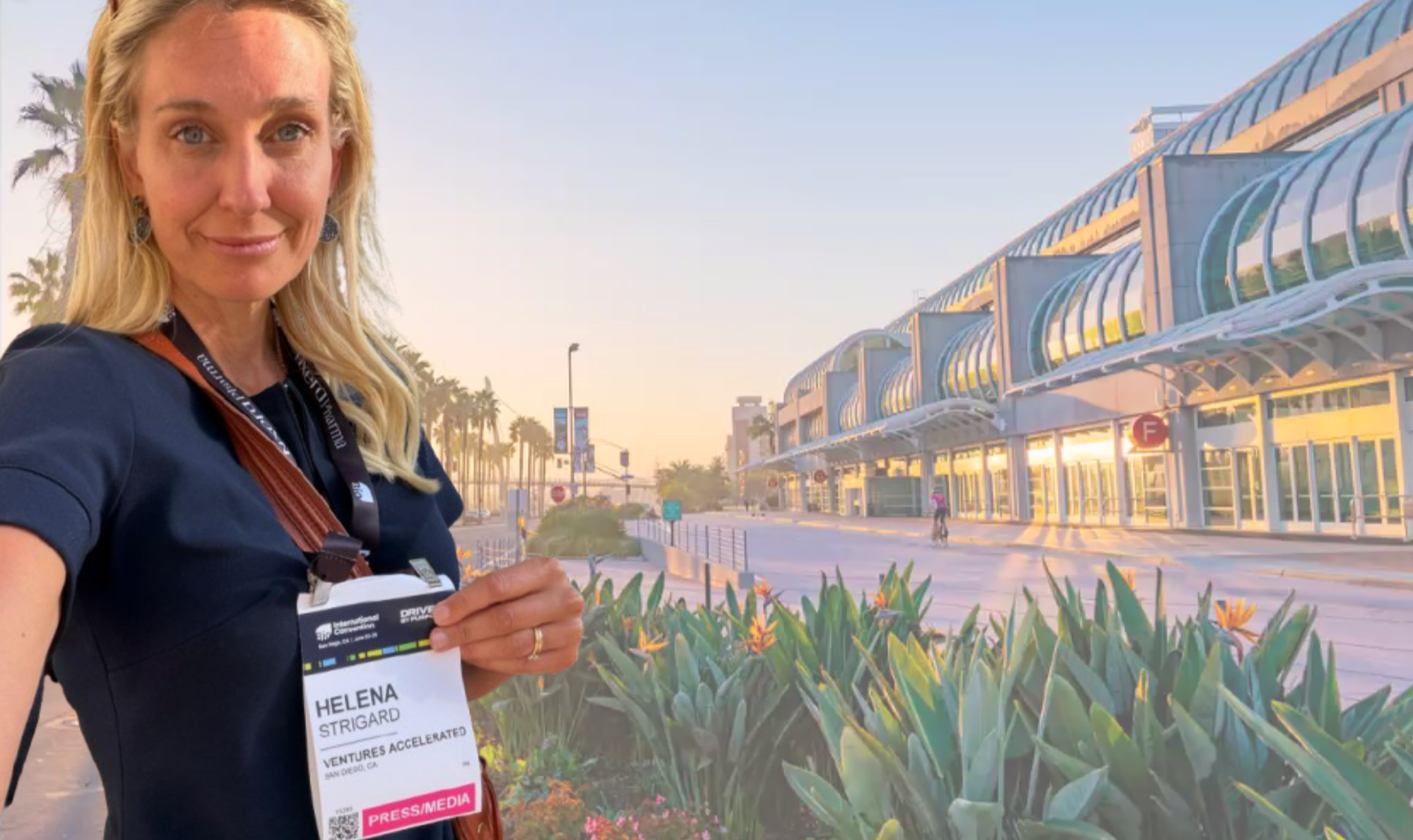
Helena Strigård
CEO and Founder of Ventures Accelerated
At BIO 2026, capital felt scarcer, more selective and more global — and the questions moved earlier. A pulse check from San Diego, across five companies working the gap between promise and proof.
“Staying in the US only is not an option anymore.”
Anna Kazatskaya came to San Diego to raise a pre-seed round for Fervid Therapeutics, the early-stage company she co-founded to develop a new anti-seizure medicine for Lennox-Gastaut Syndrome, a severe childhood epilepsy. She met several large VC firms. She did not meet the smaller funds that actually write the small checks a preclinical company needs.
What she didn’t expect was who leaned in instead: patient organizations.
“They were interested in getting involved and were willing to set up collaborations within their network,” she said — a quieter, more durable form of traction, and a hint about where some of the real energy in early-stage biotech is coming from.
Kazatskaya’s read on the market is worth sitting with, because it reframes the whole conference. In her view, the financing environment has been rough for years, and it has become even harder for the youngest companies. The reason, she argues, is specific and easy to miss: the non-dilutive government funding that preclinical companies have traditionally leaned on — NIH and NSF grants — has become less reliable, pushing companies like Fervid toward dilutive funding earlier than planned.
The knock-on effects redraw the map. US venture money, she said, mostly wants later, de-risked assets, which is why European and Chinese companies often migrate toward the US as they mature. But the arrow now points both ways. For a company at Fervid’s stage, Kazatskaya argues, raising in Europe can make more sense: smaller rounds, less dilution.
“I know quite a few companies that didn’t make it because of this disruption in funding, and I am not planning to be one of them,” she said. “The only way to make it is to be global and seek all the options that are available.”
She goes further, with the kind of forecast rarely heard on a main-stage panel: a possible dip in US M&A five to seven years from now, because so many companies starting today may not survive long enough to become acquisition targets — even as asset development accelerates in China and elsewhere. “The market will move with innovation,” she said, “and it will be progressively more and more global.”
For all that macro sweep, Fervid’s own near term is concrete. The pre-seed is meant to carry its lead molecule toward an in vivo proof-of-concept study — the “primary value-inflection point,” Kazatskaya said, that would de-risk the company’s seizure-suppression mechanism and set up its seed round.
Global strategy, in other words, in service of one very specific experiment.
That is the current running beneath BIO 2026. When capital is scarce and selective, scrutiny moves earlier — and it spreads. Investors and partners are no longer only asking whether the science is exciting. They are asking whether the model is convincing, whether the molecule can be made, whether the CMC path holds up, whether the company can fund itself globally, and whether there is an operational backbone strong enough to carry the program forward.
The most interesting conversations in San Diego were happening in that gap.
AI grows up: from concept to consequence
Jonathan Baptista, CEO of DeepLife, came to BIO for what he called “having the right conversations” — meetings with pharma, biotech and innovation teams looking for “better ways to connect complex biological data with real R&D decisions.”
His read on where AI has landed matched the mood exactly.
“Many teams are not looking for AI as a concept,” he said. “They are looking for better ways to understand where to focus, which targets to prioritize, and how to assess disease relevance before moving into more expensive validation work.”
In a market where a wrong turn costs more than it used to, that last clause is the whole pitch.
DeepLife’s platform, TwinCell, builds AI-powered digital twins of human cell types — the outgrowth of what Baptista called “a simple scientific conviction”: that to understand disease properly, “we need to understand what is happening at the level of individual cell types.” The company’s next move is to take TwinCell from scientific validation into partner-led work, where a pharma or biotech team arrives with an asset, a target list, a disease question or a dataset — and leaves with a sharper next decision.
The excitement, tellingly, was not about whether AI is powerful. It was about whether it can help companies choose better, and sooner.
Testing the story before it gets expensive
BrainStorm Therapeutics arrived with a mission — better treatments for brain diseases — and a to-do list: raise the company’s profile and connect with partners, investors and collaborators.
It ran the full BIO gauntlet, from a company presentation and Startup Stadium pitch to a panel and partnering meetings. The week, Maya Gosztyla said, “exceeded our expectations.” She framed the value in terms any early founder would recognize: the chance to “pressure-test our strategy, identify partnership opportunities, and build relationships with groups that may be important as our programs advance.”
The science speaks to the same instinct visible everywhere at BIO: de-risk earlier.
“Too many promising therapies fail because preclinical models do not adequately capture human brain biology,” Gosztyla said. BrainStorm pairs patient-derived brain organoids with AI-driven analysis, starting in rare neurodevelopmental disorders with a lead program in CDKL5 deficiency disorder. Its next milestone is moving that program from discovery-stage validation toward a development-ready therapeutic candidate.
It is worth noting that two of the most compelling early-stage stories here — Fervid and BrainStorm — are both in rare childhood neurology, and both are betting that better questions asked earlier beat bigger bets placed late.
The molecules are getting harder to make
If the early-stage companies came looking for signal, Guy Rachmuth of Just – Evotec Biologics saw a different one clearly: the industry is advancing molecules that are genuinely hard to manufacture.
Many of his conversations, he said, were with groups working on “hard-to-manufacture bispecifics or multispecifics” — “leading-edge technologies” now “dominating the discussion.”
It was a reminder that manufacturability is no longer a late-stage technical detail. For many of the most exciting modalities at BIO, it is becoming part of the investment case from the beginning.
This is where the innovation story gets complicated. Discovery is accelerating — Rachmuth called the wave of AI-driven new molecular entities and new disease biology “a fertile field” — but every new modality eventually hits the same wall: can it be made, at scale, affordably and fast enough?
Just – Evotec Biologics positions its continuous manufacturing platform as one answer to that pressure, aiming to accelerate Phase 1 clinical trial initiation and support IND submissions “in as little as 10 months.”
The same logic drives the biosimilar wave, where the stakes are both commercial and societal.
“Over $300B in commercial biologics are facing loss of exclusivity,” Rachmuth noted — a figure that turns manufacturing cost from a back-office line item into a decisive factor in whether patients get “high-quality, lower cost biosimilars” at all.
Just – Evotec’s platform combines J.CHO®, J.Media™ and J.Train™, delivering what Rachmuth described as “10x higher productivity than comparable fed-batch manufacturing approaches.” In a hall full of ambitious modalities, the quiet constraint on all of them is whether the system that makes them can keep up.
When operations becomes strategy
Evan Edwards, CEO of Kymanox, has a clear vantage point on that constraint.
Kymanox is best known for combination products and drug delivery technologies, but the San Diego conversations, he said, ran deeper — into manufacturing readiness, commissioning and validation, MS&T, quality systems, PPQ campaigns, and remediation of regulatory or compliance concerns before they sink a program.
BIO, Edwards said, is “always massive with thousands of attendees.” This year, he was especially struck by “the breadth and depth of client and partner discussions” and the “strong international presence.” Kymanox came to increase awareness of how it can “support and accelerate client programs,” and BIO delivered exactly that.
The marketplace is “quite volatile,” Edwards added, shaped by geopolitics and capital markets. Several themes cut across the week: China’s growth in the industry, AI, tighter regulatory scrutiny of CMC, and the onshoring of biomanufacturing capacity.
But one observation stood out.
What felt different this year, Edwards said, was seeing “the investment community taking CMC development more seriously than has been the case previously.”
That may be one of the clearest signs that the hard middle of biotech has moved into the spotlight.
On regulatory pressure, Edwards pointed to an “apparent uptick in regulatory actions targeting CMC areas,” particularly from the US FDA — the 483s, warning letters and CAPA work that Kymanox is increasingly called in to address. On AI, he was pointedly practical, describing tools that create efficiencies in “quality documentation generation and batch record review,” alongside work to help sponsors adopt “responsible and ethical AI use” within their quality management systems.
Onshoring adds another layer. Kymanox is supporting domestic manufacturers expanding capacity, as well as overseas companies looking to establish a stronger US foothold. Edwards said the company helps fill “crucial gaps as companies struggle to find the necessary expertise and to maintain timelines.”
Read his comments next to Kazatskaya’s and the picture completes itself: at the earliest stage, money is scrutinizing how a company will fund itself; at the later stages, investors and partners are scrutinizing whether it can manufacture, comply and scale. Pressure has moved to both ends of the chain at once.
The hard middle
Put it together and BIO 2026 did not lack ambition. But the center of gravity had shifted.
The most interesting questions lived in the hard middle of biotech — where science becomes development, development becomes manufacturing, and manufacturing becomes access. In that middle, a scarcer, more global pool of capital is asking earlier and more insistently not only, “Is this exciting?” but, “Can this actually move forward?”
For Fervid, that means turning a global financing strategy into one decisive in vivo proof-of-concept study. For DeepLife, it means proving that AI can guide real R&D choices, not just generate predictions. For BrainStorm, it means using human-relevant models to move a rare neurology program toward a development-ready candidate. For Just – Evotec Biologics, it means making complex biologics and biosimilars manufacturable at speed and scale. For Kymanox, it means helping companies build the quality, regulatory and operational backbone that lets innovation survive contact with reality.
The industry still wants breakthrough ideas. This year, more than most, it wanted to know who could carry them across the bridge — and it was increasingly willing to look beyond the usual borders to find them.